
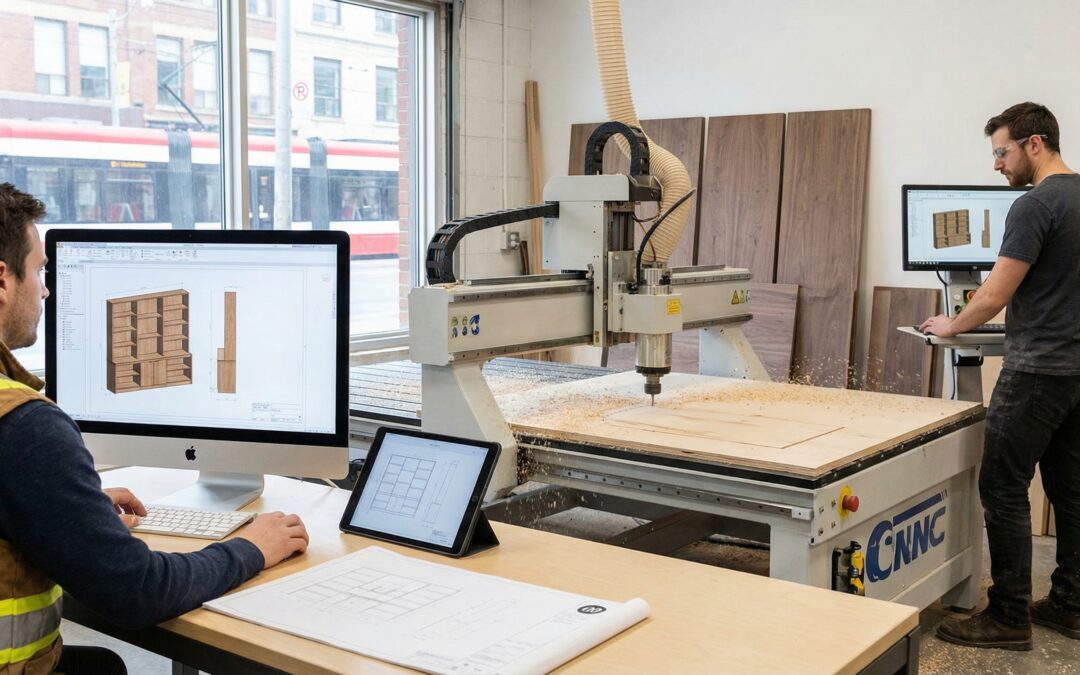
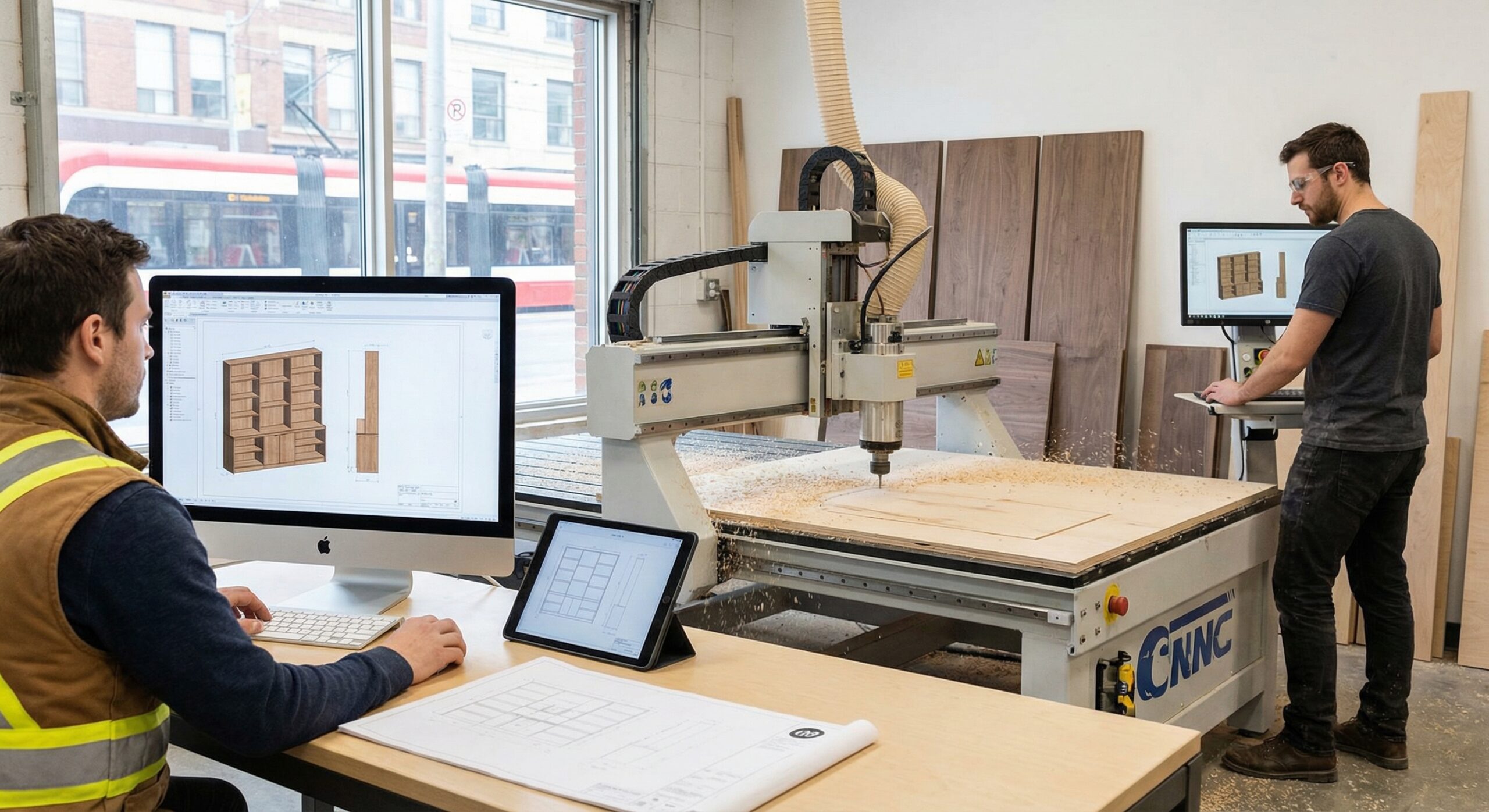
Digital fabrication has changed what “precision” means in custom millwork across Toronto, especially when your space includes older framing, condo constraints, and tight installation windows.
At RFP Design, we build architectural millwork for residences and commercial interiors where alignment matters, hardware needs to disappear, and finishes have to hold up in real life. This guide breaks down how we approach design, manufacturing, and materials so you can plan your project with fewer surprises.
If you’re comparing options, it helps to start with the basics of what millwork includes and where it delivers the most value. You can also review our overview of what custom millwork is before getting into the details.
Designing Functional Woodwork for Diverse Interior Styles
Toronto spaces ask for careful planning. Victorian and Edwardian homes in neighbourhoods like Roncesvalles or Riverdale often have out-of-square walls and layered trim profiles, while newer condos in downtown Toronto tend to limit depth, access, and installation timing.
That’s where digital fabrication supports the design phase. When the drawings match the site conditions, cabinetry lands cleanly and reads as built-in, not “fit in.”
- Tailored storage for real dimensions so built-ins follow the exact width, height, and ceiling conditions instead of forcing filler panels everywhere.
- Minimalist detailing that still works hard by using clean lines, tight reveals, and hidden hardware where it makes sense for the space and daily use.
- Seamless integration with architectural trim so new millwork aligns with crown moulding, baseboards, and existing casing profiles rather than interrupting them.
If you want examples of built-ins that look intentional and stay functional, our guide on custom built-in cabinets in Toronto pairs well with the planning steps below.
Where digital fabrication helps most in Toronto interiors
Digital fabrication supports accuracy when the site is unpredictable. That includes older homes with settling, multi-unit buildings with elevator constraints, and commercial spaces where one missed dimension can delay an opening date.
- It allows for clearer coordination between design intent and shop drawings.
- It supports repeatable precision across doors, panels, and reveals.
- It makes complex geometry easier to build cleanly, especially with curved or modular features.
Collaborative Design and Local Manufacturing Processes
Millwork goes smoothly when the process stays connected from first measure to final install. In Toronto, that connection matters because site access can be limited, timing is often compressed, and existing conditions can shift between trades.
Our workflow uses digital fabrication as part of a practical, collaborative process. You get fewer unknowns because the same team is thinking through measuring, detailing, building, and installation.
- Every project starts with a detailed site measure and a consultation focused on how you live or how the space needs to operate day-to-day.
- Components are built locally using traditional joinery where it matters, supported by modern machinery for repeatable accuracy.
- Installation is handled by an in-house crew so joints, seams, and reveals meet a consistent standard, and issues get solved on site without handoffs.
If you want a clearer sense of how we run projects end-to-end, this overview of digital fabrication explains the workflow and the capabilities behind it.
Digital fabrication and quality control in the shop
Digital fabrication supports quality because the build is tied to the model, and the checks happen before anything reaches your site. That makes a difference with:
- Door and drawer consistency across a full wall of millwork
- Repeatable drilling patterns for concealed hardware
- Panel alignment when lighting, power, and signage are integrated
Even with strong drawings, millwork still needs craftsmanship at assembly and finishing. The goal is a final product that feels refined in your hands and stays stable through real use.
Project Spotlight: Dior Christmas Tree
Some builds make the role of precision obvious right away. The Dior Christmas Tree in Toronto was a large-scale, high-visibility installation where schedule, safety, and visual impact had to line up perfectly.
Challenge: Dior and Oxford Properties envisioned a massive holiday centerpiece described as roughly 35 feet tall with an 18-foot diameter, with lighting and custom display elements integrated throughout. The project also involved a geographically distributed team working across France, Manhattan, and Toronto, which added coordination complexity.
Solution: RFP collaborated closely with Park Creative Agency and Dior to translate the concept into a buildable plan, then fabricated custom components and integrated lighting and display elements so the finished structure read as one cohesive piece. The team emphasized careful planning, engineered detailing, and controlled execution so the installation met quality and safety expectations on a tight timeline.
You can see the full case study and project details here: https://rfpdesign.com/project/dior-christmas-tree/.
Projects like this show how digital fabrication supports complex, modular builds where parts need to fit correctly the first time, especially when transportation, assembly, and on-site installation have narrow margins.
Selecting Durable Materials for Longevity and Performance
Toronto’s seasonal shifts push wood movement and finishing performance. Material choices need to handle humidity changes, daily wear, and long-term stability, whether you’re installing millwork in a residential kitchen or a high-traffic commercial space.
Digital fabrication helps here too because better joinery and tighter tolerances reduce stress points, but material selection still drives durability.
- Stable hardwoods such as white oak and walnut are common choices for cabinetry and feature millwork when you want a balance of strength, grain, and predictable movement.
- Finishing options can include low-VOC oils and high-performance lacquers chosen for durability, cleanability, and daily use resistance.
- Selection balances visual grain with structure so you get the look you want without compromising door flatness, panel stability, or hardware performance.
For clients who care about VOC limits in coatings, Canada regulates VOC concentration limits for architectural coatings, including stains, varnishes, and lacquers. That background helps explain why low-VOC finishing systems matter when you’re planning an interior project. https://www.canada.ca/en/environment-climate-change/services/managing-pollution/sources-industry/volatile-organic-compounds-consumer-commercial/architectural-coatings.html
Digital fabrication choices that support better material performance
When you pair good materials with a clean build strategy, the millwork holds up better over time. Digital fabrication supports that outcome through:
- Consistent joinery and repeatable drilling for hardware
- Cleaner fits that reduce rattling, rubbing, and misalignment
- Better planning for service access to lighting, cables, and devices in commercial interiors
FAQs
What is the typical lead time for a custom millwork project?
Timelines generally range from eight to twelve weeks depending on the complexity of the design and material availability.
Do you provide millwork for commercial office renovations?
Services cover retail displays, boardroom tables, and reception desks tailored for commercial environments throughout the GTA.
Planning a custom millwork project in Toronto
If you’re ready to scope your project, start by gathering a few basics so we can give you useful feedback quickly. That includes photos, a rough layout or inspiration references, and any constraints like condo elevator access, parking/loading rules, or after-hours installation requirements.
Digital fabrication supports precision, but a smooth experience still depends on clear goals and good site information from the start.