
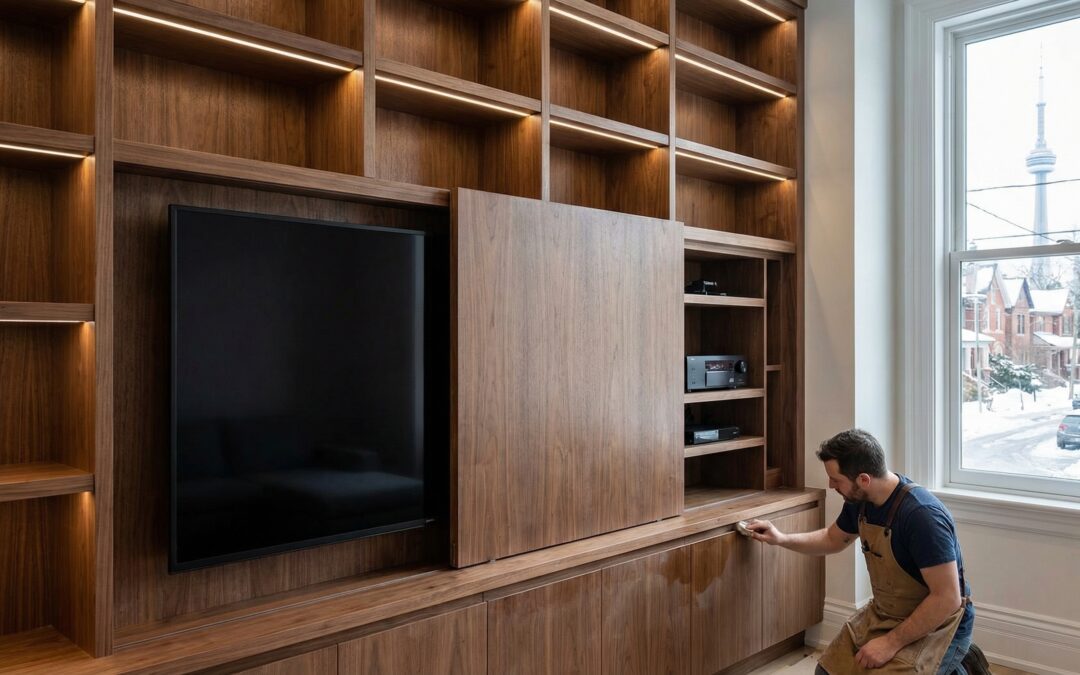

Custom furniture fabrication toronto is how you get built-ins that look like they were always part of the house, even when the walls are out of square and the floor has a slope you can feel underfoot.
Toronto homes give you every layout challenge in one city. Narrow Victorian rooms, condo walls that need every inch, and older West End ceilings that tilt where you least expect it all shape how a built-in should be designed, built, and installed.
This guide walks through the planning, the everyday functions worth building around, and the material choices that help your millwork stay tight through seasonal humidity changes.
Optimizing Layouts in Diverse Toronto Residences
Good built-ins start with the room you have, not the room you wish you had. With custom furniture fabrication toronto, the goal is to make storage feel calm and intentional while respecting the architecture.
Designing around Victorian row house constraints in neighbourhoods like Cabbagetown
Victorian row houses often come with long, narrow rooms, imperfect plaster, and trim profiles you want to preserve. A built-in needs to read as a natural extension of existing casing and baseboards.
- Shallow-depth cabinetry keeps walkways comfortable in tight living rooms and hallways.
- Trim-matching details help new millwork sit comfortably beside historic moldings.
- Scribed panels handle wavy walls so you don’t end up with filler strips that look like an afterthought.
Utilizing vertical space in modern downtown condos
Condos reward vertical thinking. Floor area is limited, and built-ins can increase usable storage while keeping the room visually clean.
- Full-height uppers capture the space above eye level for seasonal or occasional items.
- Wall-anchored systems keep the footprint tight and align with typical condo requirements.
- Integrated lighting makes tall cabinetry feel lighter and improves daily usability.
Working around radiators, slanted ceilings, and other structural obstacles in older West End homes
Older West End homes often include radiators, soffits, duct runs, and angled ceilings. A built-in works best when it acknowledges these elements and turns them into intentional features.
- Radiator covers can be integrated into a continuous run, with airflow planned from the beginning.
- Angled uppers make slanted ceilings look finished instead of forcing awkward gaps.
- Access panels keep shutoffs and service points reachable without compromising the look.
Functional Applications for Daily Living
People call us for built-ins because their home needs to work harder without feeling crowded. Custom furniture fabrication toronto makes the practical parts feel seamless.
Seamless media centers that conceal wiring and hardware
A media wall should keep your tech accessible while hiding the messy parts. Planning happens before fabrication so everything has a place, including the future upgrades you haven’t bought yet.
- Dedicated cable pathways to route power and low-voltage cleanly.
- Ventilated compartments for receivers and consoles to reduce heat buildup.
- Flush details that keep doors, reveals, and panels aligned for a tidy front view.
If you’re comparing styles and storage configurations, see related ideas in custom built-in cabinets in Toronto.
Floor-to-ceiling library walls with integrated lighting
Library walls work well in living rooms, offices, and upper landings where you want storage that also adds warmth. Lighting brings depth to shelves and supports reading without adding table lamps everywhere.
- Adjustable shelving where it matters, with fixed elements where you want clean symmetry.
- LED integration planned around wiring routes and service access.
- Detail millwork like face frames, applied moldings, or minimal slab fronts depending on the home’s character.
For a deeper look at library-specific design choices, visit custom library shelving in Toronto.
Mudroom benches and cabinetry built for Canadian seasons
Toronto weather makes entry storage a daily stress test. The right mudroom keeps wet gear contained, gives you a comfortable perch, and prevents the hallway pile-up.
- Bench seating sized for real use, paired with durable upholstery or easy-clean finishes.
- Boot storage designed around drip trays and airflow so moisture doesn’t linger.
- Hooks and cubbies laid out for bulky winter coats, backpacks, and sports bags.
Material Selection and Longevity
Materials decide whether built-ins stay crisp or start showing seasonal movement. With custom furniture fabrication toronto, you can choose substrates, joinery, and finishes that align with Toronto’s indoor humidity swings and your day-to-day wear.
Selecting hardwood and engineered materials that handle humidity shifts
Wood moves as humidity changes, and Toronto homes experience dry winter air and more humid summers. Industry guidance often targets indoor relative humidity ranges around 30% to 50% for woodwork performance. That range helps reduce stress on doors, panels, and joints over time.
- High-grade MDF performs well for painted work because it stays stable and finishes smoothly.
- Kiln-dried hardwoods remain a strong option for stained finishes when construction accounts for movement.
- Engineered cores and veneers can balance the look of wood with improved dimensional stability.
For a clear humidity reference point that’s widely cited in restoration and preservation contexts, the Canadian Conservation Institute notes that many mixed collections (including wood objects) are typically suited to a 30% to 50% RH range. See the CCI humidity guidance here.
Choosing finishes that complement existing trim and historic details
Finish decisions are visual, but they also affect maintenance. A durable clear coat in a high-touch area can reduce fingerprints and scuffs, while a painted finish can blend new built-ins into older trim lines.
- Paint matching to existing baseboards and casing for cohesive transitions.
- Stain sampling on the actual species and sheen level to avoid surprises under warm indoor lighting.
- Sheen selection based on the room’s wear, with higher sheens usually cleaning easier.
If you want a practical breakdown of stain versus paint considerations, you can also reference wood staining vs wood painting.
Hardware that stays smooth under daily use
Soft-close hinges, full-extension slides, and the right pulls make the difference you notice every day. Hardware also helps doors stay aligned when people are opening and closing them constantly.
- Soft-close hinges selected for door size and weight.
- Full-extension drawer slides for easy access in deep bases.
- Adjustability to fine-tune reveals after installation settles.
Collaborating with a Local Millwork Specialist
Built-ins succeed when the design and fabrication teams communicate clearly and measure precisely. With custom furniture fabrication toronto, you’re paying for that planning discipline as much as the finished woodwork.
Design consultation and precise site measurement
Measurements need to reflect real site conditions, including floors that slope, walls that bow, and trim that isn’t consistent from one corner to the next. This is where details like scribing, filler strategy, and installation sequencing get decided.
- Field verification for outlets, HVAC registers, and plumbing shutoffs.
- Clearances planned for doors, drawers, and appliance or tech access.
- Shop drawings that lock in proportions before anything is built.
Coordinating installation schedules in the GTA
Scheduling matters in Toronto, especially when you’re coordinating with painters, electricians, condo management, or a renovation timeline. A strong install plan protects finishes and avoids last-minute compromises.
- Delivery planning around building rules, elevator bookings, and staging space.
- On-site protection to keep floors and adjacent walls clean during install.
- Final adjustments for doors, reveals, and touch-ups once the unit is anchored.
Project Spotlight: Sammarco Italian Steakhouse
Even though Sammarco is a commercial space, it shows the same precision and coordination that clients look for when they want high-end built-ins at home. In this project, the challenge was delivering complex, high-visibility pieces with tight tolerances and integrated systems, all while keeping the design cohesive across multiple custom elements.
RFP Design Group’s solution combined careful engineering and fabrication, including a modular banquette installation designed for transport and seamless assembly, a custom curved-glass and brass divider that required tolerance control, and a back-bar with integrated storage and lighting. The result demonstrates how custom furniture fabrication toronto supports clean detailing, reliable installation, and durable performance in demanding environments.
Read the full case study here: Sammarco Italian Steakhouse.
FAQs
How long does a custom built-in project typically take?
The timeline depends on the complexity of the design and our current production schedule. Generally, the process from the initial design phase to final installation takes between eight and twelve weeks.
Can built-ins be installed in Toronto condos?
Condo installations are very common. We focus on wall-anchored units that maximize small footprints and comply with building management requirements regarding structural alterations.
What materials are recommended for durability in the GTA?
Stable materials like high-grade MDF are excellent for painted finishes, while kiln-dried hardwoods are preferred for stained projects to minimize movement caused by seasonal indoor humidity changes.
Planning a Built-in? Start with a Site-Specific Conversation
If you want built-ins that fit cleanly, function well, and hold up through Toronto’s seasons, plan them like permanent architecture, not movable furniture. That approach is where custom furniture fabrication toronto earns its keep.